
Garage Door Cable Replacement
When a garage door cable snaps, the door won’t lift, comes down crooked or drops faster than it should. We do cable jobs seven days a week and can often come the same day. Our trucks carry cables and bottom brackets, so most cable jobs need one trip. You can choose galvanized or stainless steel cables, with powder-coated brackets.





Why Homeowners Call Rise & Shine for Cable Replacement
The cables and springs share the work of lifting your door. When one cable lets go, the springs can only pull on the other side, so the door jams crooked in the tracks or comes down hard. The cable that’s still holding is now doing more than its share, which is a good reason not to wait.
A broken cable often points to trouble somewhere else, so we look at the whole door while we’re there: springs, drums, bottom brackets, rollers and the opener. If another part is close to failing, we show you and tell you the price. You decide whether to fix it now.

Available Every Day of the Week
Cables snap on Saturdays and holidays as often as on a Tuesday. We schedule cable jobs every day of the week, and a same-day visit is often possible.

Parts Already on the Truck
Our trucks carry replacement cables and the hardware that goes with them, so we rarely need a second trip to finish a cable job.

Our Own Employees, Always
We don’t hand jobs to subcontractors. The technician who knocks on your door works for Rise & Shine and has passed a background check and a drug test.

You See the Price Before We Start

Rust-Resistant Cable Upgrades

Fully Licensed and Insured
What Are Garage Door Cables and Why Do They Fail?
Two Cable Systems Used on Residential Garage Doors
Torsion Cable Systems: one or two springs sit on a shaft above the opening, with a cable drum at each end. As the springs unwind, the drums turn and wind up the cables, which pulls the door up. Torsion springs are the usual setup on newer doors. They tend to run smoother and quieter than extension springs and keep the door better balanced.

Why Garage Door Cables Break
Steel fatigue. Every trip up and down bends the cable around the drum. After enough trips, the thin wires inside it start to break one at a time, and you won’t notice until enough of them go that the cable snaps.
Corrosion from the inside out. Water works in between the strands and rusts the cable where you can’t see it. Salty slush melting off cars in a Minnesota winter speeds that up, and so does a damp, unheated garage.
A broken spring took the cable with it. When a torsion spring snaps, all its stored tension releases in an instant. The jolt can throw a cable off its drum or pull it loose at the bottom bracket.
Worn drums or a crooked track wore it down. When drum grooves wear smooth, the cable winds on crooked and rubs. A track out of line makes the door drag, and the cables take that extra load every time.
Nobody inspected them. Cables run along the edges of the door, tucked beside the tracks, so few people ever look at them. Small frays go unnoticed for months. By the time the door starts acting strange, the cable is often nearly worn through.
How to Tell Your Garage Door Cable Has Failed

The door sits crooked or tilted.
If one bottom corner sits higher than the other, one cable has most likely broken and the other is still holding its side.

You heard a loud bang from the garage.

You can see fraying or loose strands on the cable.

The door dropped fast or slammed to the ground.

Cable is dangling, loose, or wrapped around the shaft.

The opener runs but the door won't budge.
The Cable Problems We Fix Most
Snapped Cable Replacement
Most cable calls start the same way: a cable breaks, the door drops or jams, and the car is stuck inside. We put on a new cable sized for your door’s weight and check the drums, springs and brackets before we call it done.
A door that came down hard can hide other damage. We look for bent track, cracked panels and a strained opener, because those don’t always show up until the door has run a few more times.
Once a cable breaks, leave the door where it is. Lifting it by hand or hitting the opener button can bend more parts, and you’d be standing under it.
Frayed Cable Replacement
A frayed cable is wearing out a few wires at a time. You might see rough or bristly spots on it, find little bits of wire on the floor, or notice the door going up a bit unevenly. Every wire that breaks puts more load on the ones left, so the wear speeds up.
Replacing a frayed cable before it snaps is a smaller job than cleaning up after one. If rust caused the fraying, ask about stainless steel cables, which hold up much better in a damp garage.
Cable Off Drum Repair
When a cable comes off its drum, that side of the door loses its lift. The door tilts, sticks in the tracks or won’t move. It usually happens after a spring breaks, when the drum grooves are worn smooth, or when something stopped the door on its way down and the cable went slack.
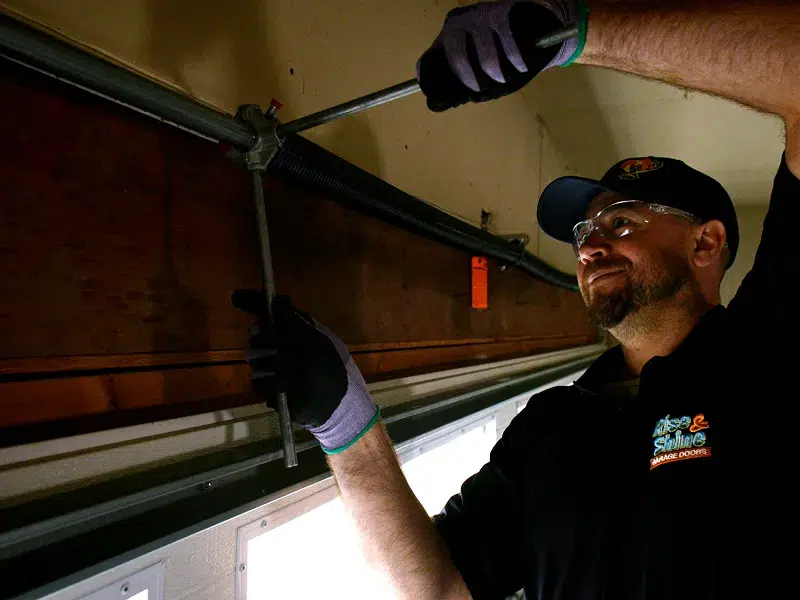
We take the tension off, check the drum for wear and put the cable back on or replace it. Then we reset the tension and run the door until it travels level.
Rusted or Corroded Cable Replacement
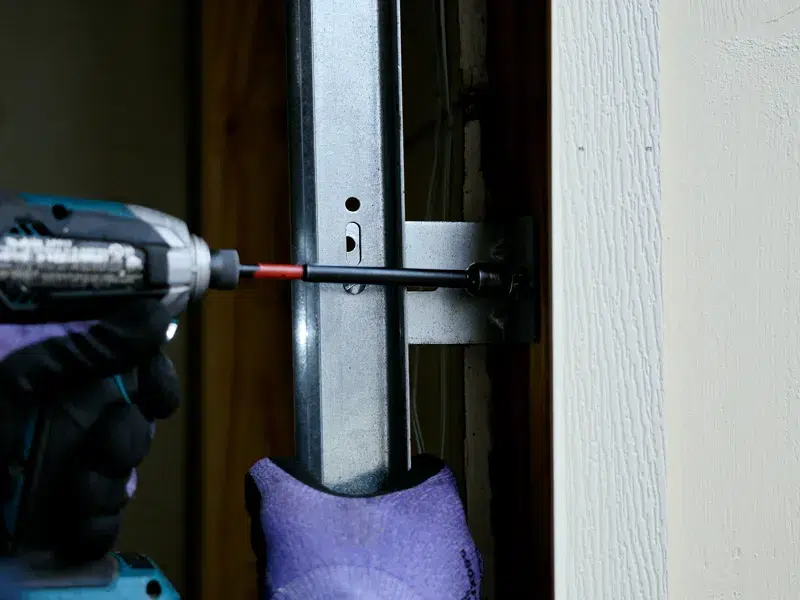
Rust starts between the wires, so a cable can be weak well before it looks bad. Once you see brown or orange spots, stiff sections or flaking, it has already lost some of its strength.
We see the most rust in uninsulated garages, in Twin Cities and Rochester garages where salty slush melts off the car all winter, and on older homes still running their original cables. When rust is the problem, stainless steel cables are worth the extra cost.
Bottom Bracket and Cable Replacement
The bottom bracket is where the cable hooks onto the door, right down at floor level where water collects. It carries the full pull of the cable every time the door moves. If a bracket rusts through or cracks, a good cable has nothing solid to hold.
A new cable on a rotten bracket won’t last, so when the bracket is bad we replace both. The powder-coated brackets we use stand up to rust better at floor level.
Galvanized or Stainless Steel Cables
Galvanized steel is the usual cable on a garage door, and it rusts in time. You can choose galvanized or stainless steel, depending on your budget and how long you want the cables to last.
Standard Galvanized Steel Cables
Stainless Steel Cables (Lifetime Option)
Replace One Cable or Both?
Same age, same wear
Mismatched cables cause tracking problems.
One visit covers both.
What Happens When You Call Us
Step 1: Schedule by Phone or Online
Call 833-865-7473 or book a time on our website. Describe what the door is doing and we’ll set up a visit, often for the same day.
Step 2: Inspect the Full System
Your technician looks at the cables first, then the drums, springs, bottom brackets, tracks, rollers and opener. When one cable fails, nearby parts are often worn too, and it’s better to find that now.
Step 3: Review the Quote
Before any work starts, you get a written price for parts and labor. The bill at the end matches it.
Step 4: Replace the Cables
We let the tension off the springs, take off the old cables, fix any drum or bracket problems and put on the new cables. Then we balance the door. Most cable jobs are done in under two hours.
Step 5: Test Everything
We run the door up and down several times and watch that it stays level. We lift it by hand to check the balance, then test the auto-reverse and the opener.
Step 6: Walk You Through Maintenance
Before we go, we show you what a worn cable looks like and what to listen for. A look at the cables now and then and a yearly tune-up help them last.
What Happens If You Wait
A small repair becomes a bigger one.

Your opener burns out.

The door becomes a safety hazard.
You lose access to your garage.
Design Your Perfect Garage Door
Try styles and colors on a picture of a house before you choose a new door.
Frequently Asked Questions
How long does it take to replace garage door cables?
Most cable replacements are done in under two hours. Worn drums, a cracked bracket or a tired spring adds time, and we’ll tell you about any extra work and its price before we start it.
What does cable replacement cost?
It depends on galvanized or stainless steel cable, one cable or both, and whether the brackets or drums need replacing. You’ll have the full price before we start.
Is it safe to use my door if the cable looks frayed?
No. A frayed cable can go at any moment, and if it breaks while the door is moving, the door can fall. Leave it closed if you can and call us to replace the cable.
Should I replace both cables even if only one broke?
Can I replace garage door cables myself?
We’d advise against it. Changing a cable means taking the tension off the springs, and one slip with the winding bars can cause a serious injury. Our technicians carry the right bars for it.
What's the difference between galvanized and stainless steel cables?
Can you come out today?
Do you work on commercial garage doors?
What warranty do you offer on cable replacement?
How do I prevent cable problems in the future?
We’re in Your Area
Minneapolis • St. Paul • Twin Cities Metro • Austin